 Role of Biomarkers in MS Research
ACCELERATE THE NEXT GENERATION OF MS TREATMENTS
Why Biomarkers Are Critical to MS Research
A biomarker is a biological sign of a normal or abnormal process, or of a condition or disease. A biomarker may be used to see how well the body responds to a treatment for a disease or condition. Currently, MRI scans are the only biomarker – or measurement – used in MS research. But MRIs cannot accurately measure if a treatment truly promotes myelin repair, which represents the next generation of MS treatments.
To accelerate the development of new treatments, MRF is focused on identifying additional biomarkers that can be assessed via blood tests – which are faster, less invasive, lower cost and more specific than MRI. These new biomarkers will benefit the millions worldwide living with MS by enabling smaller and faster clinical trials.
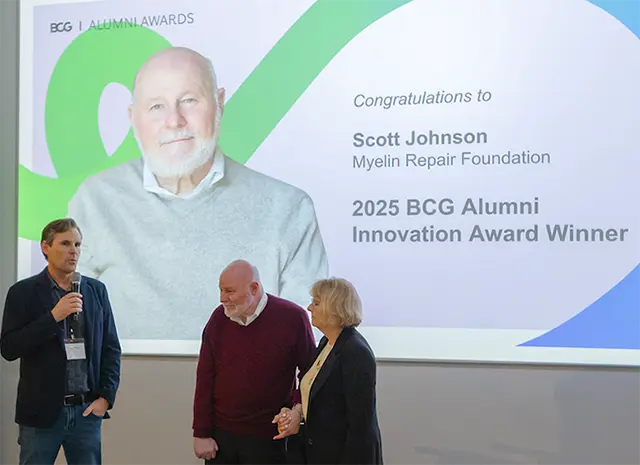 Scott Johnson receives Innovation award from Boston Consulting Group (BCG)
BCG, a global consulting firm (one of the Big Three management consulting companies in the world) has named Scott Johnson as its 2025 Alumni Innovation Award Winner in recognition of the significant research results MRF has achieved under Scott’s leadership. “I’m honored to receive this award from a prestigious organization like BCG because it highlights the success of MRF’s approach to research that is helping millions of people with MS, and potentially other neurological diseases.”
President’s Letter
 Dear Friends and Supporters of MRF,
In our drive for effective MS treatments to repair myelin, MRF continues to make strong progress on our development of a myelin repair biomarker:
- Over the past year, we have funded important new research projects at Yale, Columbia, McGill, Cornell, and the University of Barcelona. Plus, we will be announcing additional research that will be getting underway in the coming months.
- By funding all these different research projects, we’re able to test and develop multiple biomarker assays with very positive results: the research data is showing that our assays are highly accurate.
- We are attracting the interest of key pharmaceuticals with our results and are currently in talks with more than a dozen companies as we work to ensure the success and wide commercial adoption of our myelin repair biomarker.
I’m very excited and confident about MRF’s biomarker progress!
I often get asked why MRF is so focused on developing a myelin repair biomarker. The simple answer: MRF took on this difficult and daunting task because it would not have gotten done otherwise. Developing a new biomarker is expensive, takes many years, and is inherently risky. And successful development and commercialization requires collaboration between academic research and pharma, which is rare due in part due to IP-related issues.
So in 2017, when commercial pharma shared with us the need for a myelin repair biomarker and noted that no effort to develop one was even being contemplated, MRF answered the call!
We knew MRF was uniquely suited to developing a myelin repair biomarker due to our strengths and expertise:
- As a neutral non-profit, we can bridge the gap between academic research and commercial pharma.
- We have a proven 22-year track record of using scientific collaboration to mitigate risk and accelerate results based on clear measurable stretch goals and attentive management.
- We have the expertise to identify and engage the top scientists in biomarker research, and the funding necessary to support their efforts. Currently we have funded a total of 41 biomarker-related studies.
- We have the credibility and contacts with pharma to move biomarker assays from academic labs to commercial testing and usage.
As an MS patient driven and supported organization, nothing will deter our focus on achieving a myelin repair biomarker.
The entire MRF team is pleased and motivated by the progress we have made and the implications for accelerating myelin repair treatments to MS patients who can’t afford to wait. Your support is needed for us to complete this critical endeavor! Please donate today.
Sincerely,

MRF Biomarker Research
Generous donations from supporters like you fund this critical research.
May 2026
MRF funds our seventh experiment with Dr. Linden at Cornell. This work will include proteomic analysis and RNA sequencing to reveal MS-specific signatures in oligodendrocyte/myelin, neuron, astrocyte, brain-endothelial, and immune-derived EV compared to Healthy Controls. In addition, it will examine the molecularly distinct profiles based on lesion activity of MS patients.
March 2026
MRF funds Dr. Antel at McGill University. This work builds on two prior experiments to define the proteome of EVs derived from cultured human oligodendrocytes (OLs). It will establish the conditions for purifying OL EVs for proteomics and then analyze the OL EV proteome. Based on the proteins identified, a list of commercially available antibodies for proteins that are expressed on the surface of OLs will be identified
February 2026
MRF funds a third experiment at the University of Barcelona. It will isolate and characterize total EVs from paired plasma and CSF samples of patients with relapsing-remitting MS and primary progressive MS, and non-inflammatory neurological controls (individuals with headache and normal MRI).
July 2025
MRF funds Dr. Shur at Columbia University to identify microglial EV biomarkers in MS using CSF and iPSC-microglia. He will isolate and enrich extracellular vesicles (EVs) from the CSF of MS patients and healthy controls then perform targeted gene expression analysis. This will allow comparison to gene expression profiles among healthy controls, stable MS patients, and progressive MS patients.
May 2025
MRF funds a follow-up experiment at Yale to enable, via a specific exosome-based biomarker signature, earlier and more accurate detection of MS progression, which in turn allows for more timely treatment interventions, better clinical trial design, and, ultimately, the development of more effective therapies for progressive MS.
December 2024
MRF funds a study at Yale University that uses plasma-derived exosomes. Identifying an exosome-based biomarker for MS progression and treatment responses would constitute a major advance in MS patient care and clinical trials by allowing for a more precise patient selection and providing additional outcome measures.
September 2024
MRF organizes and conducts a very successful Myelin Repair Biomarker Symposium to summarize the state of the art and inform pharmaceutical companies with myelin repair drug development efforts about the capabilities of biomarkers identified by MRF. Representatives from more than 20 companies attended.
September 2024
MRF funds development of reliable, reproducible assays as a platform for biomarker discovery in multiple sclerosis progression as well as other neurological diseases. The assay isolates, from patient blood serum, EVs from brain cells, then concentrates the targeted EVs and analyzes the messages carried by those EVs.
March 2024
MRF funds a follow-on study at the University of Barcelona of astrocyte-derived extracellular vesicles. Astrocytes are thought to be critical for feeding both neurons and oligodendrocytes as well as creating a local environment in the brain that is conducive for repair.
February 2024
MRF begins a study of human CNS-endothelial cells and oligodendrocytes to determine the specific molecular signature of ETX-induced EV secretion in MS patients. Such a signature would generate a novel diagnostic tool and would help generate new therapeutic targets to inhibit and repair both ETX-induced BBB permeability and demyelination.
November 2023
MRF initiates a study at the Montreal Neurological Institute to identify the EV signatures, derived from microRNAs, from damaged / stressed oligodendrocytes and neurons. This will potentially lead to the discovery of clinically relevant biomarkers of disease progression.
September 2023
MRF funds development of reproducible assays to obtain cell type-enriched EVs from oligodendrocytes, neurons, astrocytes, and CNS-endothelial cells isolated from blood samples to access their EV cargo as indicators of myelin repair. Subsequent validation and optimization of these assays would then provide an analytic pipeline of characterized CNS, cell-specific EVs for drug development programs.
June 2023
Building upon MRF’s EV research results, MRF funds new assay development in Switzerland to increase the throughput of oligodendrocyte and astrocyte EV isolation and analysis from blood samples.
May 2023
MRF funds a new research project at Johns Hopkins University to image the iron laden microglia in the rim of chronic active MS lesions as a biomarker of remyelination or neuroprotection.
May 2023
MRF enters into a collaboration with NanoSomiX to use their technology to evaluate plasma-derived neuronal and oligodendrocyte EVs as biomarkers.
Nov 2022
Katie Whartenby, PhD, joins MRF’s research staff. For the last two decades, Katie had a lab at Johns Hopkins University focused on understanding autoimmune responses in MS.
“Although hundreds of thousands of scholarly scientific articles are published every year, the FDA approves less than two-dozen new drugs a year. What's missing is the translation of all that cutting-edge science into cutting-edge cures. That's where the MRF comes in.”
Scott Cook, Co-Founder, Intuit
“The Myelin Repair Foundation's model—which brings together researchers and works to ensure that their work is relevant to development of patient treatments—is a critical innovation at a time when our system of drug development is looking for new ideas.”
Elliot Gerson, Aspen Institute and Rhodes Trust
“There are many foundations funding research on different diseases, but fewer that are investing in the infrastructure to manage that research more effectively.”
Nancy Barrand, Special Advisor for Program Development, Robert Wood Johnson Foundation
“Innovation is a decidedly social process encompassing diverse individuals, corporations, communities, networks, and regions. The work of the Myelin Repair Foundation is an excellent demonstration of these principles.”
John Hagel, Co-Chair, Deloitte LLC, Center for Edge Innovation
“I am drawn to new ideas that have the potential to change a market. I am inspired by the MRF's business model and advanced medical research concepts. MRF is a non-profit, but it breaks every rule and barrier to the speed of a start-up with the agility of a successful business.”
Samantha Fein, Managing Director, Threxy
“Unlike a lot of other organizations, the Myelin Repair Foundation really understands the intersection between academia and pharma. And if you're going to make a difference in MS, myelin repair is where you're going to have to put your efforts. We are putting efforts there.”
Craig Sorensen, Vice President, Vertex Pharmaceuticals
“Working with MRF is an unmistakable path for me to bring effective therapeutics — and new hope — for all patients in need.”
Beatrice Perotti, Ph.D., M.B.A., President and CEO, Beatrice Perotti, Inc.
“Breaking down barriers between academic research and commercial drug development will be the centerpiece of the Myelin Repair Foundation's legacy.”
William K. Bowes. Jr., Founder Amgen, U.S. Venture Partners
“Through our funding, we look for ways to make medical research more relevant to health improvement. MRF's leadership in transforming the research paradigm is very compelling to us.”
Lynne Garner, Trustee & President, Donaghue Foundation
“We view the Myelin Repair Foundation's Accelerated Research Collaboration model as just that, a transformative idea with the potential to pioneer a new approach to medical research that can speed the discovery process and lead to the development of new treatments.”
Carl Schramm, President and CEO, Ewing Marion Kauffman Foundation
“Not enough progress has been made, fast enough, toward effective treatments for MS. I am involved with the Myelin Repair Foundation because I really believe in the methodology: Getting the best people together to solve a really tough problem collaboratively. I truly believe that the Myelin Repair Foundation offers real hope.”
Julie Wainwright, Founder and CEO, SmartNow.com
“MRF's collaborative model is … definitely accelerating results. The scientists have made important advances that, if the labs had been working on their own, would have been much less likely.”
Brian Popko, Ph.D., University of Chicago, Director, Jack Miller Center for Peripheral Neuropathy, Associate Chair for Research, Department of Neurology
“I support the MRF for two reasons. Personally, I have a connection to MS: My husband has MS. But even beyond that, the vision of Myelin Repair Foundation and the method that they are proving out to get drugs to people faster is a really big vision that is important for a lot of unmet medical needs and it is exciting to be a part of it.”
Sharon Wienbar, Managing Partner, Scale Venture Partners
“If you just leave it to basic scientists working alone in their own labs, converting basic scientific discoveries into drugs almost never happens. Without the ARC model there is no infrastructure for accelerating drug development.”
Ben Barres, M.D., Ph.D., Stanford University School of Medicine, Chair, Neurobiology Department
“Disease foundations play an important role in funding early stages of research when other research and investment dollars are scarce. I am impressed by what the Myelin Repair Foundation is doing to encourage collaboration. MRF's model is novel and spot-on in terms of moving innovative research forward.”
Gail Maderis, President and CEO, BayBio: Northern California's Life Science Association
“The Myelin Repair Foundation has identified the best labs in a defined area and brought them together with excellent and independent minds from the pharmaceutical industry to advance the most promising ideas for novel therapeutics.”
Martin Raff, M.D., Emeritus Professor, University College London
“Collaborative innovation — bringing together people from different disciplines, with complementary skills — is a powerful strategy for solving complex problems. The MRF's model provides important lessons for the pharmaceutical industry, which faces a crisis of innovation in developing treatments for complex diseases.”
Karim R. Lakhani, Harvard Business School
“Not enough progress has been made, fast enough, toward effective treatments for MS. I am involved with the MRF because I really believe in the methodology: Getting the best people together to solve a really tough problem collaboratively. I truly believe that the MRF offers real hope.”
Ted Yednock, Executive Vice President, Head of Global Research, Elan Pharmaceuticals
“I believe the most striking accomplishment has been the success of the model. The thought that one could get several excellent basic scientists to work in a united effort with a clinical target in mind is really impressive... Not only has the group worked together, but there are now products of this effort. Very impressive!
Henry F. McFarland, M.D. (Ret.), National Institutes of Health